It's been a while, but that's for good reason. I think many of us are moving into a phase of life right now, whether because of the time of year or the kinds of things we're involved in.
Just to keep the spirit alive here, I wanted to post this announcement for those who may not be aware that the LDS Film Festival has issued a call for entries for 2009. Click the link for guidelines and details.
Wednesday, October 8, 2008

Tuesday, September 23, 2008
LDS Audience Improvement
I have a question. It may be an old question, but I think it bears repeating. I suppose I'm asking this in tandem with this post from A Motley Vision. My scope is narrower as a result of being specific to this blog's audience. The assumption I'm basing my question on is that Latter-day Saints tend to view cinema in largely the same that the world presents it. We may or may not be more discriminating in what we will partake of, but we generally go for the same things in terms of what motivates us to see a movie and what reasons we give for thinking it worthwhile. We, as a people, tend to consider film watching a pastime - a break from the other parts of our lives. We go see movies for fun or for something to do and we think we had a worthwhile experience when the movie was exciting, we laughed a lot, there were cool special effects, the acting was good, we cried, there was some moral lesson, the company was enjoyable, and/or suchlike. I know there are strong opinions otherwise held by some who read this blog, but I'm speaking generally. This is my basic assumption.
It seems to me that a lot of thoughtful LDS filmmakers would like to change the way audiences approach the viewing experience. There is an apparent disconnect between the intentions of those who make the films and those who view them. My question is this: should this disparity be resolved and, if so, how? How can the LDS audience be improved?
We talk a lot about improving the art and the artists, but it seems to me that neither will flourish as readily without an equally improved audience. With whom does the onus for changing the perceptions of the audience lie? It is, in my opinion, a necessarily gradual process, but I was hoping we could have a discussion about that and what you all think can be done.
It seems to me that a lot of thoughtful LDS filmmakers would like to change the way audiences approach the viewing experience. There is an apparent disconnect between the intentions of those who make the films and those who view them. My question is this: should this disparity be resolved and, if so, how? How can the LDS audience be improved?
We talk a lot about improving the art and the artists, but it seems to me that neither will flourish as readily without an equally improved audience. With whom does the onus for changing the perceptions of the audience lie? It is, in my opinion, a necessarily gradual process, but I was hoping we could have a discussion about that and what you all think can be done.
Wednesday, September 17, 2008
Art in the Midst of Artifice
I ran across a video on YouTube that I absolutely loved. It was a performance by Paul Potts of one of the most beautiful songs I know, Nessun Dorma. True it was on Brittain's Got Talent, a show of the type that I have a general disdain for, and true, the sweeping camera moves were mightily distracting, but the beauty of the music combined with the humility of the singer (both in background and in character) was overwhelming. It was filled with light. It was art.
I have marveled since at how powerfully that light penetrated my being. I have heard this song outside of the context of its opera before, but the last time it was sung by a man who, in my interactions with him that day, was arrogant, impatient, and condescending. To me, that tarnished the experience. Plus, the performance had a "look how amazing I am" tone to it. Mr. Potts never approached that attitude, although I have found such shows as the one that featured him to nurture the vice. His singing was service. It edified both him and the audience and they rejoiced together. He didn't do it (at least discernibly) for the attention.
I mentioned the camera moves. They were terrible. But the performance maintained its purity in spite of them. It also fended off the general clutter of YouTube, including an adjacent thumbnail ad for a video featuring topless photos of a well known celebrity. I normally find such things so offensive that I don't allow them any presence on my computer screen, but in this case it and all the other distractions were eclipsed by the purity (I'll use the word again) of the performance.
Perhaps it was a spiritual connection that I needed at the time, but it came back when I showed the video to my wife and children hours later. I originally came across it quite by accident, as I don't normally peruse YouTube. Maybe that had something to do with it.
Whatever it was, the experience is altering and improving, I hope, my ideas about art. I experienced how a single, unintentional, perhaps even unconscious element of a production can connect so powerfully with an audience that everything calculated and conditioned falls into insignificance. That element becomes art and the rest is just trappings. The art represents the soul of the artist as expressed through his art. It opens the spiritual channel that we've discussed here before. This reminds me of the mission I served, where I was taught that my imperfections as a messenger could be brought to naught through spiritual communication. Born of sincerity, this connection is, to my mind, wrought more by the tools that build character than the tools that build a film, or a vocal performance, or any other thing perceptible to the five senses. I wonder if we can't take a lesson from Mr. Potts' example of humility and apply it to our making and viewing of film.
I have marveled since at how powerfully that light penetrated my being. I have heard this song outside of the context of its opera before, but the last time it was sung by a man who, in my interactions with him that day, was arrogant, impatient, and condescending. To me, that tarnished the experience. Plus, the performance had a "look how amazing I am" tone to it. Mr. Potts never approached that attitude, although I have found such shows as the one that featured him to nurture the vice. His singing was service. It edified both him and the audience and they rejoiced together. He didn't do it (at least discernibly) for the attention.
I mentioned the camera moves. They were terrible. But the performance maintained its purity in spite of them. It also fended off the general clutter of YouTube, including an adjacent thumbnail ad for a video featuring topless photos of a well known celebrity. I normally find such things so offensive that I don't allow them any presence on my computer screen, but in this case it and all the other distractions were eclipsed by the purity (I'll use the word again) of the performance.
Perhaps it was a spiritual connection that I needed at the time, but it came back when I showed the video to my wife and children hours later. I originally came across it quite by accident, as I don't normally peruse YouTube. Maybe that had something to do with it.
Whatever it was, the experience is altering and improving, I hope, my ideas about art. I experienced how a single, unintentional, perhaps even unconscious element of a production can connect so powerfully with an audience that everything calculated and conditioned falls into insignificance. That element becomes art and the rest is just trappings. The art represents the soul of the artist as expressed through his art. It opens the spiritual channel that we've discussed here before. This reminds me of the mission I served, where I was taught that my imperfections as a messenger could be brought to naught through spiritual communication. Born of sincerity, this connection is, to my mind, wrought more by the tools that build character than the tools that build a film, or a vocal performance, or any other thing perceptible to the five senses. I wonder if we can't take a lesson from Mr. Potts' example of humility and apply it to our making and viewing of film.
Friday, September 12, 2008
Field of Dreams

It's been a while since I've posted. So, I thought that while Trevor is occupied I would continue my discussion of spiritual lessons that I'm learning from the cinema.
The spiritual implications of Field of Dreams have probably been discussed quite a bit, but I can't help but mention a few important principles that I'm learning from the film. First, the film obviously addresses personal revelation--that an individual can receive personalized spiritual direction from God. One of the scenes that I like most is when Ray discusses a spiritual prompting he has received with his wife, who is (understandably) skeptical. But having both shared the same dream the previous night, the husband and wife receive a mutual confirmation of the importance of this prompting. This shared spiritual confirmation and the immediate show of support that follows, I think, offers a powerful lesson in the process of spiritually-directed, family decision-making.
I also appreciate the representation of heaven as situated in rural Iowa. Not only does it echo the doctrine of a celestialized earth, but also it implies the need for us to work to prepare our earth to receive its paradisical glory--If we build it, He will come.
And lastly, I love that as Ray follows the promptings to build a field for Shoeless Joe, ease Terrence Mann's pain, and allow Doc Graham to live his dream, he is given the opportunity to-- with his family--become reconciled with his estranged Father. As he follows the Spirit and serves others, his own salvation is made possible. I find that very profound.
So, I will continue sharing some of the things that I'm learning from films, but I would love to hear about your experiences as well. Are there films that have offered you spiritual insights that you'd care to share? Maybe we can learn together.
Tuesday, September 9, 2008
The Mormonization of the Modern Fairy Tale

Certain activities in my life have led me to take interest in a company called RHI Entertainment (formerly Hallmark Entertainment), that produces, distributes, and licenses long form television content. One of RHI's fairly recent releases is a reinterpretation of The Wonderful Wizard of OZ called Tin Man.
I read a review of Tin Man that got me thinking.
The author (Maureen Ryan of the Chicago Tribune) said, speaking of L. Frank Baum, "It’s almost as if the writer was planning ahead, not just for his own series of sequels, but for the latter-day artists and writers who’ve found endless creative possibilities in the realm of Oz."
After listing some other Oz interpretations and briefly mentioning the film's central themes, she continues, "Sure, those well-worn concepts are not the most original starting points for stories, but those themes have endured for generations because they resonate not just with kids but with everyone who’s ever felt like an outcast."
So this got me thinking about how frequently people try to reinvent "classic" stories and try to turn them into blockbusters, social commentary, or whatever else they have in mind. RHI, for example, has films in its archives that give new interpretations to stories such as Jack and the Beanstalk, Gulliver's Travels, Snow White, Jason and the Argonauts, etc....
But we also see this in Mormon films too. Pride and Prejudice and Beauty and the Beast are the two that spring most immediately to my mind, but even classic Mormon stories like Johnny Lingo have already seen remakes. Plus there are a whole host of LDS films that take scriptural stories as their themes.
I'm wondering why it is that this is so popular, especially with the fairy tales and classic literature. Does this come from an impulse to claim mainstream but potentially meaningful works as our own, as seems to have been done with the writings of CS Lewis and others? I know some people who seem to look at the Narnia movies as church-sanctioned productions (this may be only a slight exaggeration). On the other side of that, are we sometimes trying to make our ideas seem compatible with mainstream lore, and therefore culture? Do we simply want to rearrange the tales so that they can be seen from what we consider to be an ideal LDS perspective (in order either to use them as teaching tools or to justify embracing what we might otherwise not)? If so, are we uncomfortable with or unwilling to consider them from other perspectives, not obviously LDS? If so, does that indicate an attachment to the natural man (the aforementioned desire to embrace the world's culture by ignoring its incompatibility with our perception of gospel culture)?
I realize that not all of the questions above apply to every classic story (or even all of the ones I've listed) and that my list of questions is not complete, but I'm not supposed to say everything there is to say on a topic. I'm interested in your thoughts on the place of fairy tales and classic literature in LDS filmmaking. What do you think?
Sunday, August 31, 2008
Light, Truth, Spirit, and Cinema Part Three: The Perfect Day
So, this line of writing has seemed to me to be somewhat unproductive, but I thought I would give it one more chance. Please bear in mind that nothing I say should be construed as an outright approval or condemnation of any work in its entirety and that no comment of mine is meant to be exclusionary of other ideas or in any way final or absolute. These are ideas that I hope we can work through together. I hope this legalistic disclaimer prevents at least some misunderstanding of my intentions here.
Let me start with the promised quotation from Alma 32.
O then, is not this real? I say unto you, Yea, because it is light; and whatsoever is light, is good, because it is discernible (Alma 32:35).
This is one of the most interesting light verses in all the scriptures to me, because it gives the reason why light is so good, and in so doing, further connects it with truth. We all know that the Lord tailors His speech to our imperfect understanding, and light assists in this regard. Our temporal natures endow us with a tendency to trust what we see with our eyes. In other words, if we can see it, it's easier to understand and believe. We sometimes give greater weight to evidence that is readily perceptible.
This is one of the most interesting light verses in all the scriptures to me, because it gives the reason why light is so good, and in so doing, further connects it with truth. We all know that the Lord tailors His speech to our imperfect understanding, and light assists in this regard. Our temporal natures endow us with a tendency to trust what we see with our eyes. In other words, if we can see it, it's easier to understand and believe. We sometimes give greater weight to evidence that is readily perceptible.
Interesting to me that Alma says that an evidential witness that causes our minds to expand and our souls to swell is real because it is light. This hearkens back to my other post on this subject that mentioned the "messenger" function of the photon. When we consider light, truth, and spirit to be one, this makes perfect sense.
Additionally, Alma says that all light is good because it is discernible - i.e. we can comprehend it, or it is truthful. The Spirit speaks to our spirit and we understand.
That's quite a concept for a filmmaker, in my opinion. According to Alma, not only does light imply truth, but it actually establishes reality and goodness. Again, I have to say that this really seems obvious in retrospect. I don't think that I'm guiding anyone through deep and uncharted intellectual territory here. I'm talking about things that we all get intuitively but that I, at least, have not often heard or seen discussed verbally.
How many films adorn the "good guys" with light and cloak the "bad guys" in darkness? How many films would exist without the ability to create a reality using light? Probably none. The medium itself wouldn't exist.
This raises some interesting questions for me, because it seems to me that a growing number of films are featuring protagonists whose lives are not only touched by, but defined by darkness. In other words, the good - or the reality we are supposed to accept as true - is coming from the darkness. Interestingly, in many cases, so is the evil. Only rarely do I see a film in which any antagonistic forces are surrounded by light, especially white light. The Fellowship of the Ring and The Two Towers come to mind as examples of films that have elements of this.
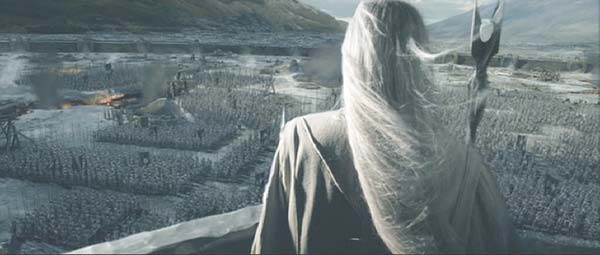
I'd be willing to guess that some of you reading this think I'm talking about The Dark Knight. Well, I'm not. At least not exclusively. I still haven't seen that and so can't comment on it so specifically. I do think of Daredevil while I write this, as well as The Chronicles of Riddick, only one of which I've seen - and that was a TV version. I just remember that the narrator of that movie said that sometimes good is too weak to fight evil, and therefore it must be fought by a different kind of evil. Hmmmm.
Kate DiCamillo's beautiful book, The Tale of Desperaux deals with light and darkness in a way that I think sets a good example. I hope the animated version of it coming out this December doesn't forsake that. I would love to see a serious animated version of that book.
Going back to Alma, in the next verse, he says that the above mentioned experience with light does not equal perfect knowledge - at least not in the sense that "perfect" means "complete." Faith is still required.
I mention this because it seems to me that this takes the didacticism out of the thing I've been saying in this series. A film can present, through the united medium of light, truth, and spirit, a reality to be considered by the viewer. Light can be used to set forth ideas as true or false, to impress concepts related to good and evil, and to open spiritual communication with the viewer. But the film that does this does not require the viewer to lay aside his/her faith. In other words, the application of the film to the individual viewer is not dictated by the film itself. As much as it may have seemed so previously, I am not advocating shallow, preachy films that overuse obvious symbolism. I'm saying that an understanding of the spiritual nature of natural light can help a filmmaker harness the power of his tools.
The last thing I wanted to mention was a quotation from Harold B. Lee's Stand Ye in Holy Places. Here it is:
One is converted when he sees with his eyes what he ought to see; when he hears with his ears what he ought to hear; and when he understands with his heart what he ought to understand. And what he ought to see, hear, and understand is truth-eternal truth-and then practice it (Lee, Stand Ye in Holy Places, 92).
Here's my take on the application of this quote to filmmaking. A movie that doesn't mean anything is, well, meaningless. The goal in film is not always, or even often, to convert, but it should't be. Film uses spirit, but only the Spirit can convert. One thing a film can do is manage its use of light to enhance spiritual communication - to provide an opportunity for truth to be taught by presenting ideas that the viewer may not countenance in any other context. In this way, physical light can open a pathway for spiritual light to show, tell, and teach a person the truths "he ought to see, hear, and understand." Remembering our assumption that physical light is the spirit of Christ, in this way, a film can become "the light which shineth in darkness, and the darkness comprehendeth it not" (Doctrine and Covenants 10:58).
I think this should be the goal of LDS filmmaking: not conversion, but awakening, enlarging - preparing the mind and heart for the teaching of the Holy Ghost. This can be done in a limitless number of ways, and it won't work for every viewer, but I think it should never be forgotten. If my films can't contribute positively to someone's spiritual journey, they ought not to be.
The process can be begun with the film, but in the continuation of it lies the great potential. “He that receiveth light, and continueth in God, receiveth more light; and that light groweth brighter and brighter until the perfect day.”18
The process can be begun with the film, but in the continuation of it lies the great potential. “He that receiveth light, and continueth in God, receiveth more light; and that light groweth brighter and brighter until the perfect day.”18
Tuesday, August 26, 2008
Update.
So I didn't go to Bill Viola, and a wonderful decision that was. I somehow forget how stressful moving is every time... and international moves with a small child doesn't make things any easier. My wife and I had plans to take care of things while we were staying in Utah on my way to Los Angeles for Film School. Our eyes were bigger than our stomachs (which was worsened by an extra day in travel due to missing connecting flights).
I'm at the American Film Institute's Conservatory, and homeless to boot. I'm really imposing on a friend of a friend's hospitality, and pirating internet access to post this. My family is in another state until we find affordable housing.
I'm planning on making some changes here, but right now is what they are terming "boot camp" and my life is consumed. I'm very grateful that my Sunday was clear, and I am planning to make that a rule, but the buzz word "24/7" is thrown around here a LOT, so we shall see. I'm learning a great deal, but I may not have much ability to write about it for some time.
I'm at the American Film Institute's Conservatory, and homeless to boot. I'm really imposing on a friend of a friend's hospitality, and pirating internet access to post this. My family is in another state until we find affordable housing.
I'm planning on making some changes here, but right now is what they are terming "boot camp" and my life is consumed. I'm very grateful that my Sunday was clear, and I am planning to make that a rule, but the buzz word "24/7" is thrown around here a LOT, so we shall see. I'm learning a great deal, but I may not have much ability to write about it for some time.
Monday, August 11, 2008
Film Languages and the "Real Story"
 I was just writing on my blog about an experience I had with Arnold Friberg at a dinner where he was receiving an award. I thought it was relevant to what we do here, so I wanted to repeat it. This is mostly verbatim from my other post:
I didn't meet him. I only heard him speak. At 95 years old, it wasn't easy for him. He said two things, however that I wanted to write down and comment on. The first thing was about how he speaks.
He said that some people speak in the language of words, but he speaks in the language of paint. He said that since he forgot to bring his brushes with him that evening, he was having a hard time.
The second thing was about his painting Peace, be Still, shown above. About that, he said the following - paraphrased: In paintings of this scene today, you see a lot of waves. That's dramatic, but it isn't the story. The story isn't the storm, it's that a man stood up and said to the storm, "be still" and it obeyed.
Although Friberg is a painter, not a filmmaker, we probably all know his connections with the film industry. I thought that it would be worth our while, as his first comment suggests, to consider the various languages involved in creating and viewing film.
I also think that the second comment of Mr. Friberg's - about the real story - is something we could profitably consider in our own film activities, be it production or interpretation.
What do you think?
Monday, August 4, 2008
Do I go (about Bill Viola)?
Right before we got to Poland last year, another Bill Viola exhibition closed. It crushed me to find how close I was to the exhibition just missing it by a few weeks and a short train ride. As I've written before, I consider Viola to be one of the most important American filmmakers especially for those interested in spirituality. I have yet to encounter someone who took his work on their terms who was not moved by them.
The majority of criticisms I hear are on the cliche nature of the discussion of his work, but I've yet to come across a valid argument for the devaluation of his installations or video work.
Do to the nature of installations, access to such video work is severely encumbered for those of us hicks who are moved by the avant-garde.
So we're moving (and international moves are quite severe, aren't they?), and less than an hour ago I finished a grueling shoot and just now I sat down to read an email advertising another Bill Viola exhibition in Gdansk (we're about 7 hours away). The opening is Friday. We leave Sunday evening after church.
So much stress, and yet I can't imagine being able and not going.
I will almost surely not go, but I wonder how much sleep I'll lose if I don't.
The majority of criticisms I hear are on the cliche nature of the discussion of his work, but I've yet to come across a valid argument for the devaluation of his installations or video work.
Do to the nature of installations, access to such video work is severely encumbered for those of us hicks who are moved by the avant-garde.
So we're moving (and international moves are quite severe, aren't they?), and less than an hour ago I finished a grueling shoot and just now I sat down to read an email advertising another Bill Viola exhibition in Gdansk (we're about 7 hours away). The opening is Friday. We leave Sunday evening after church.
So much stress, and yet I can't imagine being able and not going.
I will almost surely not go, but I wonder how much sleep I'll lose if I don't.
Friday, August 1, 2008
The Filmmaker as Rebel
I think the seeds of this writing came from a recent Elders' Quorum lesson in which we talked about diversity in the Church compared with the scriptural imperative to be of a single heart and mind. I commented then, and still think, that something about worldly philosophies has subtly twisted the value of diversity into a mindset that values rebellion, non-conformity, and unfettered individualism. In other words, when Isaiah points out that "all we like sheep have gone astray; we have turned every one to his own way" (Isaiah 53:6) the world replies, "Oh, good. We should all try to be ourselves."
I've found this philosophy to be especially apparent in the arts. I'm not sure why that should be so other than the deeply personal nature of art, but it seems to me that art, and film more so than some other media, has become a vehicle of choice for rebellious personalities. There's a mindset that says, "If I make a film, I can show my rage against the system," or "Since I'm such a rebel, I should make a film about it." You get the idea. Film itself seems to have become a symbol of extreme individualism - particularly independent film. Interesting that it should be called that.
I'm all in favor of personal expression and I recognize the diverse ways and means of the Spirit, but it seems to me that LDS filmmakers should shy away from this mold. I commented on another post about Richard Dutcher and whether or not his personal apostasy was related to his filmmaking path. I don't know the answer to that, but when I think of Brigham Young and his ideas about how the stage can reinforce the teachings from the pulpit, I wonder if it is wise in us to hold edginess and envelope-pushing as values in the creation of art, as we sometimes do.
It seems to me that honesty, charity, and other virtues should be at the forefront of our portrayals, whatever other devices or approaches we take. I also think that personal worthiness on the part of the artist - and by this I mean temple worthiness at least - is paramount. There is another kind of worthiness that has to do with whether our character can support our knowledge and creativity, and Katsuhiro Otomo's film Steamboy gives what I consider to be an excellent discussion of it.
I think I'll leave it there for now, but I would like your ideas on this. I want to know if I'm the only one who sees it this way and, if not, where we go from here.
I've found this philosophy to be especially apparent in the arts. I'm not sure why that should be so other than the deeply personal nature of art, but it seems to me that art, and film more so than some other media, has become a vehicle of choice for rebellious personalities. There's a mindset that says, "If I make a film, I can show my rage against the system," or "Since I'm such a rebel, I should make a film about it." You get the idea. Film itself seems to have become a symbol of extreme individualism - particularly independent film. Interesting that it should be called that.
I'm all in favor of personal expression and I recognize the diverse ways and means of the Spirit, but it seems to me that LDS filmmakers should shy away from this mold. I commented on another post about Richard Dutcher and whether or not his personal apostasy was related to his filmmaking path. I don't know the answer to that, but when I think of Brigham Young and his ideas about how the stage can reinforce the teachings from the pulpit, I wonder if it is wise in us to hold edginess and envelope-pushing as values in the creation of art, as we sometimes do.
It seems to me that honesty, charity, and other virtues should be at the forefront of our portrayals, whatever other devices or approaches we take. I also think that personal worthiness on the part of the artist - and by this I mean temple worthiness at least - is paramount. There is another kind of worthiness that has to do with whether our character can support our knowledge and creativity, and Katsuhiro Otomo's film Steamboy gives what I consider to be an excellent discussion of it.
I think I'll leave it there for now, but I would like your ideas on this. I want to know if I'm the only one who sees it this way and, if not, where we go from here.
Subscribe to:
Posts (Atom)